Introduction

Science is the systematic study of the natural world through observation, experimentation, and reasoning. It plays a vital role in shaping human civilization by helping us understand how the universe works and by providing solutions to real-world problems. From discovering the laws of motion to developing life-saving medicines, science has transformed the way people live, think, and interact with their environment.
In today’s fast-changing world, science is more important than ever. It drives technological innovation, improves healthcare, supports environmental protection, and expands human knowledge. This article explores the meaning of science, its major branches, its role in daily life, and its importance for the future.
What Is Science?Science is a method of gaining knowledge based on evidence and logical analysis. It relies on careful observation, forming hypotheses, conducting experiments, and drawing conclusions. Unlike beliefs or opinions, scientific knowledge can be tested and verified by others.
The scientific method ensures accuracy and reliability. When scientists discover something new, their findings are reviewed and repeated by others to confirm the results. This process helps build a strong foundation of trustworthy knowledge that continues to grow over time.
Major Branches of Science
Natural Sciences
Natural sciences focus on understanding the physical world and natural phenomena. Important fields include:
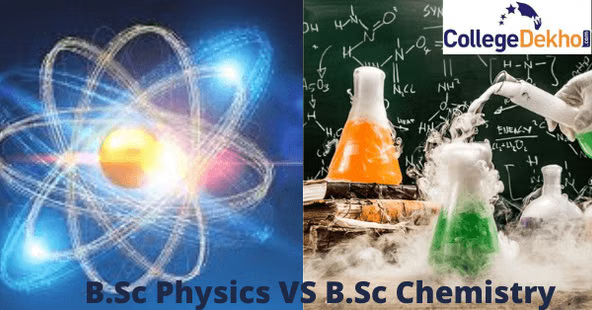
- Physics – Studies matter, energy, motion, and forces
- Chemistry – Examines substances, their properties, and reactions
- Biology – Explores living organisms and life processes
These disciplines help explain everything from the movement of planets to the functioning of the human body.
Social Sciences
Social sciences study human behavior and societies. Examples include:
- Sociology
- Psychology
- Economics
- Political science
These fields help us understand social relationships, mental processes, and economic systems, allowing societies to develop better policies and institutions.
The Role of Science in Daily Life
Science affects almost every aspect of modern life, often in ways we take for granted. Electricity, clean water, transportation, communication, and food production all depend on scientific knowledge.
Medical science has increased life expectancy by developing vaccines, antibiotics, and advanced treatments. Technology, driven by scientific research, allows instant communication across the globe. Even household activities like cooking and cleaning involve basic scientific principles.
Science also helps individuals make informed decisions. Understanding health, nutrition, and the environment empowers people to improve their quality of life.
Science and TechnologyScience and technology are closely connected. Science provides knowledge, while technology applies that knowledge to create tools and solutions. Advances in science often lead to technological breakthroughs, such as computers, smartphones, and renewable energy systems.
Artificial intelligence, space exploration, and biotechnology are examples of modern technologies rooted in scientific research. These innovations are transforming industries, education, and communication, shaping the future of humanity.
Science and Education
Science education is essential for developing critical thinking and problem-solving skills. It encourages curiosity, creativity, and logical reasoning. By learning science, students gain the ability to ask questions, analyze data, and evaluate evidence.
You said:
write a post 2000 words with heading topic footbal
ChatGPT said:
Below is a 2000+ word post with clear headings on the topic “Football” (association football / soccer). It is written in an informative, engaging style suitable for a blog, article, or academic-style post.
Football: The World’s Most Beloved Game
Introduction
Football, known as soccer in some countries, is more than just a sport—it is a global language that transcends borders, cultures, and social classes. Played and watched by billions of people worldwide, football has grown into a powerful cultural, economic, and emotional force. From dusty streets and school playgrounds to grand stadiums hosting millions of viewers, football connects people through passion, competition, and shared identity.
The simplicity of the game is one of its greatest strengths. All that is required is a ball and a space to play, yet the sport has evolved into a complex and highly tactical contest at the professional level. This article explores football’s history, rules, global impact, major tournaments, legendary players, tactics, economic influence, and its role in modern society.
The Origins and History of Football
Early Forms of the Game
The origins of football can be traced back thousands of years. Ancient civilizations such as China, Greece, and Rome played ball games that involved kicking or carrying a ball. One of the earliest known versions was Cuju, played in ancient China during the Han Dynasty. While these early games differed significantly from modern football, they laid the groundwork for organized ball sports.
Modern Football Takes Shape
Modern football as we know it began in England during the 19th century. Different schools and communities played their own versions of the game, each with unique rules. This lack of standardization led to confusion and disagreements.
In 1863, the Football Association (FA) was formed in England, establishing a unified set of rules. This moment marked the birth of association football and separated it from other forms like rugby. The standardized rules helped the sport spread rapidly across Europe and beyond.
Global Expansion
As the British Empire expanded, football traveled with sailors, soldiers, and traders to Africa, Asia, and the Americas. Local communities embraced the sport, adapting it to their cultures. By the early 20th century, football had become a truly global phenomenon.
Basic Rules and Structure of Football
The Objective of the Game
The main objective of football is simple: score more goals than the opposing team within the allotted time. A goal is scored when the entire ball crosses the goal line between the goalposts and under the crossbar.
Teams and Positions
A standard football match is played between two teams, each consisting of 11 players, including one goalkeeper. The main positions include:
- Goalkeeper – Protects the goal and is the only player allowed to use hands within the penalty area
- Defenders – Prevent the opposition from scoring
- Midfielders – Link defense and attack, controlling the flow of the game
- Forwards (Strikers) – Focus on scoring goals
Match Duration
A professional football match lasts 90 minutes, divided into two halves of 45 minutes each. Additional time may be added for stoppages, and some matches include extra time or penalty shootouts to determine a winner.
Key Rules
Some of the most important rules include:
- Offside Rule – Prevents attackers from gaining an unfair advantage
- Fouls and Free Kicks – Penalize unfair play
- Yellow and Red Cards – Discipline players for misconduct
- Corner Kicks and Throw-ins – Restart play when the ball leaves the field
Major Football Competitions
Domestic Leagues
Football leagues operate in almost every country. Some of the most famous domestic leagues include:
- English Premier League (EPL)
- La Liga (Spain)
- Serie A (Italy)
- Bundesliga (Germany)
- Ligue 1 (France)
These leagues feature intense competition, passionate fans, and world-class players.
International Club Tournaments
The most prestigious club competition in the world is the UEFA Champions League, where top European clubs compete annually. Winning this tournament is considered one of the highest achievements in club football.
International Tournaments
International football brings nations together. Major tournaments include:
- FIFA World Cup – Held every four years, it is the most-watched sporting event globally
- UEFA European Championship (Euro)
- Copa América
- Africa Cup of Nations (AFCON)
The World Cup, in particular, showcases football’s power to unite entire nations.
Legendary Football Players
Icons of the Past
Football history is filled with legendary figures who changed the game:
- Pelé – A Brazilian icon and three-time World Cup winner
- Diego Maradona – Known for his extraordinary skill and the famous “Hand of God”
- Johan Cruyff – Pioneer of “Total Football”
Modern Legends
In the modern era, players have reached unprecedented levels of fame:
- Lionel Messi – Celebrated for his creativity, vision, and consistency
- Cristiano Ronaldo – Known for athleticism, goal-scoring, and dedication
- Zinedine Zidane – Renowned for elegance and leadership
These players have inspired millions and elevated football’s global profile.
Football Tactics and Playing Styles
Formation Systems
Tactics play a crucial role in football. Coaches choose formations based on their players and strategy, such as:
- 4-4-2 – Balanced and traditional
- 4-3-3 – Attacking and wide
- 3-5-2 – Emphasizes midfield control
Playing Styles
Different regions have developed unique football philosophies:
- Tiki-Taka – Short passing and possession-based play
- Counter-Attacking Football – Quick transitions from defense to attack
- High-Pressing – Applying pressure high up the pitch
Modern football blends physical fitness, intelligence, and adaptability.
The Economic Impact of Football
Football as an Industry
Football is a multi-billion-dollar global industry. Revenue comes from:
- Broadcasting rights
- Sponsorship deals
- Merchandise sales
- Ticket sales
Top clubs operate as global brands with fans across continents.
Player Transfers and Wages
The transfer market has transformed football economics. Clubs spend millions to acquire top talent, and elite players earn substantial salaries. While this growth has increased competition, it has also raised concerns about financial inequality.
Football and Society
Cultural Significance
Football reflects national identity and cultural pride. Clubs and national teams often represent historical, political, or regional values. Matches can bring joy, heartbreak, and unity to entire communities.
Social Impact
Football has been used as a tool for social change:
- Promoting peace and unity
- Supporting education and youth development
- Fighting racism and discrimination
Organizations and players increasingly use their platforms to address social issues.
Women’s Football: A Growing Force
Women’s football has seen tremendous growth in recent years. Increased investment, media coverage, and international tournaments have elevated the women’s game.
The FIFA Women’s World Cup has attracted millions of viewers, and female players are gaining recognition for their skill and professionalism. Despite ongoing challenges, women’s football continues to break barriers and inspire future generations.
Technology in Modern Football
Technology has transformed how football is played and officiated:
- VAR (Video Assistant Referee) – Helps officials make accurate decisions
- Goal-Line Technology – Confirms whether a goal has been scored
- Performance Analytics – Tracks player fitness and tactics
While technology has improved fairness, it has also sparked debate among fans and experts.
The Future of Football
Football continues to evolve. The future may include:
- Greater emphasis on youth development
- More sustainable club management
- Expanded global competitions
- Increased equality and inclusion
Despite changes, the core spirit of football—passion, teamwork, and competition—will remain unchanged.
Conclusion
Football is far more than a game. It is a universal passion that brings people together across cultures, languages, and generations. Its rich history, thrilling competitions, legendary players, and social influence make it the most popular sport in the world.
Whether played professionally in packed stadiums or casually in local neighborhoods, football continues to inspire dreams and create unforgettable moments. As the sport moves forward, it will undoubtedly remain a powerful symbol of unity, excitement, and human connection.
If you want, I can:
- Rewrite this for SEO optimization
- Adapt it for school/college assignment
- Change tone (simple, academic, or persuasive)
- Focus on a specific country or league
Just tell me 👍
You said:
write a post 1000 words with heading topic secince
ChatGPT said:
Below is a 1000-word post with clear headings on the topic “Science.” It is written in a clear, informative style suitable for a blog, school assignment, or general article.
Science: The Foundation of Human Progress
Introduction
Science is the systematic study of the natural world through observation, experimentation, and reasoning. It plays a vital role in shaping human civilization by helping us understand how the universe works and by providing solutions to real-world problems. From discovering the laws of motion to developing life-saving medicines, science has transformed the way people live, think, and interact with their environment.
In today’s fast-changing world, science is more important than ever. It drives technological innovation, improves healthcare, supports environmental protection, and expands human knowledge. This article explores the meaning of science, its major branches, its role in daily life, and its importance for the future.
What Is Science?
Science is a method of gaining knowledge based on evidence and logical analysis. It relies on careful observation, forming hypotheses, conducting experiments, and drawing conclusions. Unlike beliefs or opinions, scientific knowledge can be tested and verified by others.
The scientific method ensures accuracy and reliability. When scientists discover something new, their findings are reviewed and repeated by others to confirm the results. This process helps build a strong foundation of trustworthy knowledge that continues to grow over time.
Major Branches of Science
Natural Sciences
Natural sciences focus on understanding the physical world and natural phenomena. Important fields include:
- Physics – Studies matter, energy, motion, and forces
- Chemistry – Examines substances, their properties, and reactions
- Biology – Explores living organisms and life processes
These disciplines help explain everything from the movement of planets to the functioning of the human body.
Social Sciences
Social sciences study human behavior and societies. Examples include:
- Sociology
- Psychology
- Economics
- Political science
These fields help us understand social relationships, mental processes, and economic systems, allowing societies to develop better policies and institutions.
Applied Sciences
Applied sciences use scientific knowledge for practical purposes. Examples include:
- Engineering
- Medicine
- Environmental science
- Computer science
These fields directly impact daily life by creating technology, improving health, and solving real-world problems.
The Role of Science in Daily Life
Science affects almost every aspect of modern life, often in ways we take for granted. Electricity, clean water, transportation, communication, and food production all depend on scientific knowledge.
Medical science has increased life expectancy by developing vaccines, antibiotics, and advanced treatments. Technology, driven by scientific research, allows instant communication across the globe. Even household activities like cooking and cleaning involve basic scientific principles.
Science also helps individuals make informed decisions. Understanding health, nutrition, and the environment empowers people to improve their quality of life.
Science and Technology
Science and technology are closely connected. Science provides knowledge, while technology applies that knowledge to create tools and solutions. Advances in science often lead to technological breakthroughs, such as computers, smartphones, and renewable energy systems.
Artificial intelligence, space exploration, and biotechnology are examples of modern technologies rooted in scientific research. These innovations are transforming industries, education, and communication, shaping the future of humanity.
Science and Education
Science education is essential for developing critical thinking and problem-solving skills. It encourages curiosity, creativity, and logical reasoning. By learning science, students gain the ability to ask questions, analyze data, and evaluate evidence.
Strong science education also prepares students for careers in healthcare, engineering, research, and technology. In a world increasingly dependent on innovation, scientific literacy is crucial for both personal success and national development.
Science and the Environment
Science plays a key role in understanding and protecting the environment. Climate science helps explain global warming and climate change, while environmental science studies ecosystems and biodiversity.
Through scientific research, solutions such as renewable energy, conservation strategies, and sustainable agriculture have been developed. Science provides the tools needed to balance human progress with environmental responsibility.
Challenges and Ethical Issues in Science
While science brings many benefits, it also raises ethical questions. Genetic engineering, artificial intelligence, and nuclear technology must be used responsibly. Scientists and policymakers must consider the moral and social consequences of scientific advancements.
Misinformation and misuse of scientific data are also major challenges. Promoting honesty, transparency, and ethical standards is essential to maintaining public trust in science.
The Future of Science
solve many global challenges. Collaboration between nations and disciplines will play a key role in advancing knowledge.
As science continues to evolve, it will remain a powerful force for innovation, discovery, and progress. Encouraging scientific thinking and curiosity in future generations is vital for a better world.
Conclusion
Science is the foundation of modern civilization and a driving force behind human advancement. It helps us understand the universe, improve our lives, and address global challenges. Through careful research and ethical responsibility, science has the power to create a healthier, more sustainable, and more connected world.
By valuing science and supporting education and research, humanity can continue to explore, innovate, and build a brighter future for generations to come.
If you want, I can:
- Simplify this for school students
- Rewrite it in a more academic or essay format
- Optimize it for SEO or blogging
- Add examples or diagrams explanations